
Padel court construction in the UK is best approached as a commercial build project, not a court “install.” Planning approval, structural tolerances, groundworks, services integration and operational requirements all shape programme, cost and long-term performance, especially in warehouse conversions and multi-court leisure environments. This guide sets out the full delivery framework: design standards, UK compliance, indoor vs outdoor engineering, cost drivers, timelines and how to select the right construction partner for a reliable, investable outcome.
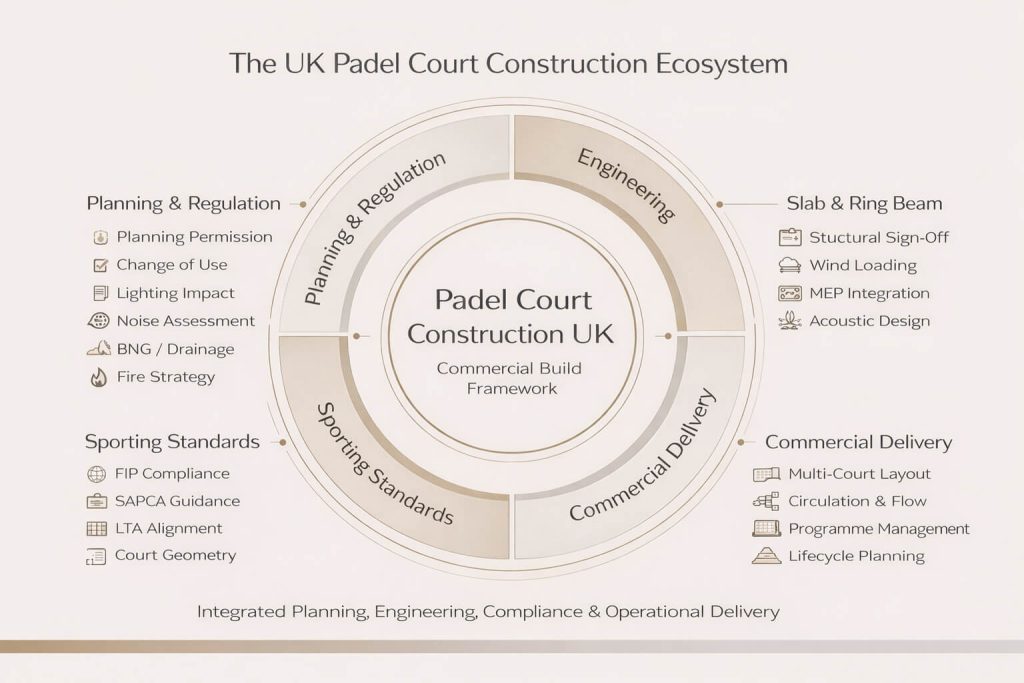
Table of Contents
- Why Padel Construction Is a Specialist Discipline in the UK
- UK Padel Court Design Standards & Compliance
- Indoor vs Outdoor Padel Court Construction in the UK
- Groundworks, Foundations & Structural Engineering
- Planning Permission & UK Regulatory Considerations
- Change of Use
- Commercial Multi-Court Developments
- Padel Court Construction Costs in the UK
- Construction Timeline & Delivery Phases
- Choosing a UK Padel Construction Partner
- Frequently Asked Questions
Why Padel Construction Is a Specialist Discipline in the UK
Padel court construction in the UK is not a simple product installation. It is a regulated construction project that requires coordination between structural engineering, planning compliance, sporting standards and commercial delivery. While courts themselves may appear modular, the environments in which they are built rarely are.
In the UK market, padel facilities are typically delivered within complex contexts: warehouse conversions, mixed-use retail destinations, regeneration sites, education campuses and high-footfall leisure environments. Each brings its own regulatory constraints, technical risks and operational demands. Treating padel construction as a straightforward supply-and-install exercise often results in costly redesign, planning delays, acoustic issues or structural remediation.
This is why padel construction must be approached as a specialist discipline.
UK Regulatory Complexity
Unlike some international markets, UK padel developments sit within a tightly regulated planning and building control framework. External courts may trigger considerations around lighting spill, residential noise impact, drainage and biodiversity requirements. Indoor courts introduce fire strategy, means of escape, accessibility compliance and structural certification obligations.
Even where courts are installed within existing buildings, change-of-use applications, slab load assessments and MEP upgrades may be required before installation can proceed. Early-stage feasibility and planning strategy are therefore critical. Projects that fail to address these constraints at the outset often encounter delays once statutory approvals are engaged.
Reluxe approaches padel construction with a full understanding of this regulatory landscape, coordinating design, engineering and compliance from the earliest stages of feasibility.
Indoor vs Outdoor Construction Considerations
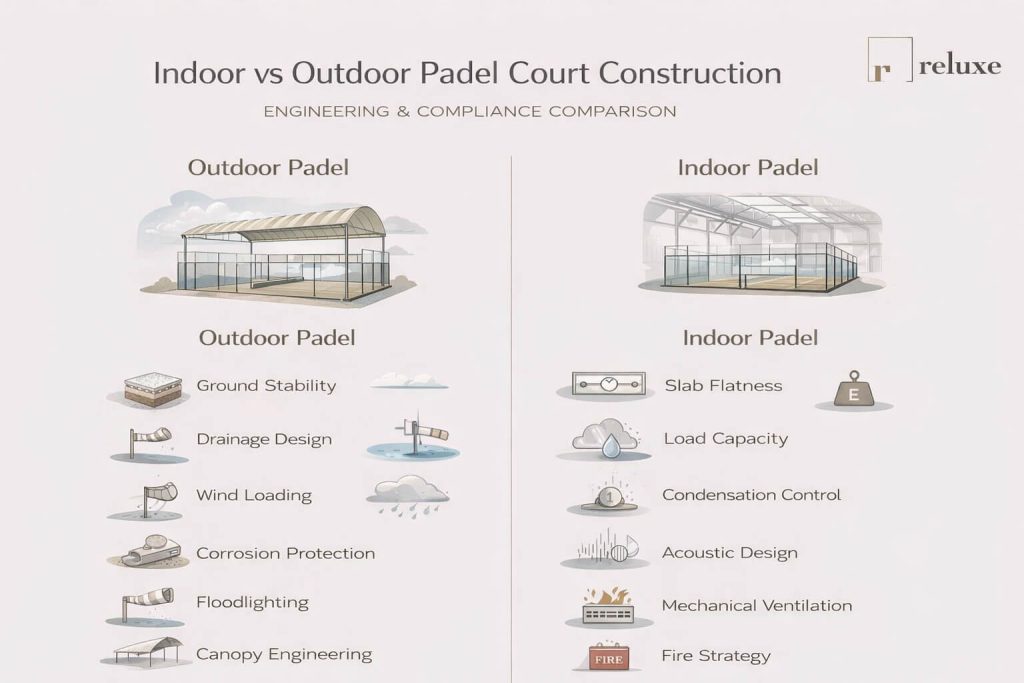
Indoor and outdoor padel courts present fundamentally different technical challenges.
Outdoor construction must account for ground stability, drainage design, wind loading and long-term corrosion protection. Canopies introduce additional structural engineering requirements and often alter planning strategy. Groundworks tolerances and reinforced ring beam design are essential to ensure enclosure stability over time.
Indoor installations, particularly within warehouse conversions, demand close scrutiny of slab flatness, load capacity, ceiling clearance, lighting design and ventilation performance. Condensation control, acoustic treatment and mechanical extraction systems must be engineered alongside court installation to maintain long-term performance and user comfort.
Each environment requires coordinated technical decision-making, not a standardised solution.
Planning, Structural Engineering & Compliance
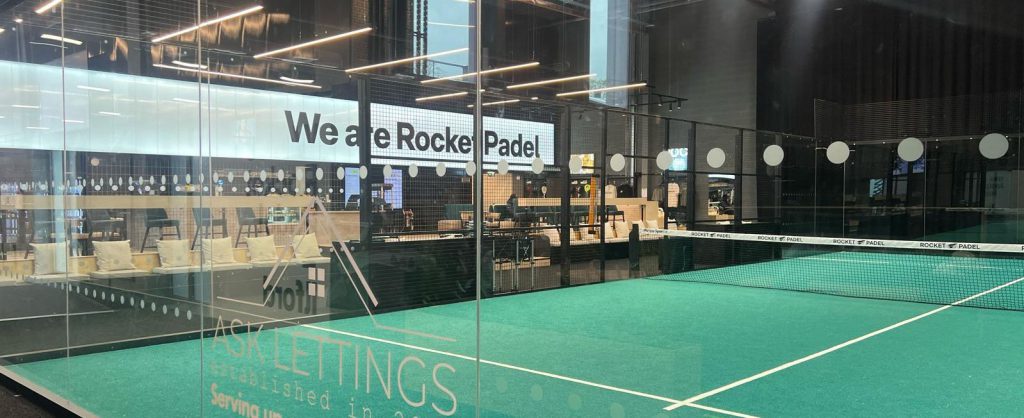
Padel courts are enclosed steel and glass structures anchored to reinforced concrete bases. The geometry must be precise. Slab tolerances must be controlled. Structural interfaces must be verified by qualified engineers. Lighting levels must meet sporting standards while avoiding glare. Emergency egress routes must remain unobstructed.
These requirements extend well beyond product supply.
Successful UK padel developments require early integration between architect, structural engineer, contractor and specialist installer. Reluxe manages this coordination, ensuring that compliance with sporting standards aligns with building regulations and commercial objectives.
For further context on how padel differs from traditional sports builds, see our article on
Why padel construction is different to traditional sports builds.
Multi-Court Commercial Environments
The UK padel market is increasingly driven by multi-court commercial facilities rather than single recreational installations. Two, four, eight or more courts are frequently delivered within high-footfall leisure destinations, often integrated alongside retail, food and beverage or gym environments.
In these contexts, circulation space, spectator viewing, acoustic management, operational flow and phased delivery all become critical design considerations. Court spacing affects playability. Lighting layout affects visibility across multiple courts. Structural programming must align with wider landlord and tenant requirements.
Delivering these environments requires commercial construction experience, not just court assembly.
Our approach to managing complex leisure developments is explored further in
From planning to completion: managing complex leisure projects.
Supplier vs Construction Partner
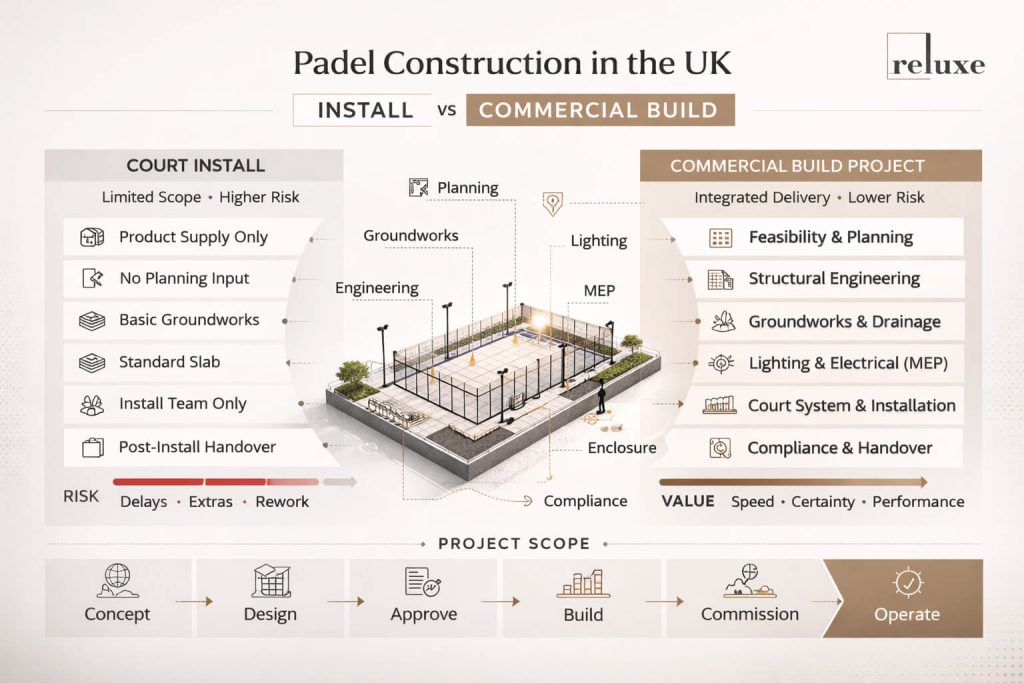
There is an important distinction between a padel court supplier and a construction partner.
A supplier typically provides the court system and installation team. A construction partner coordinates feasibility, planning, groundworks, structural engineering, services integration, programme management and commercial delivery. In regulated UK environments, that distinction matters.
Reluxe operates as a construction partner. We work alongside operators, landlords and developers to deliver compliant, high-performance padel facilities within complex commercial settings.
Padel may be modular in appearance. Its successful delivery in the UK is not.
UK Padel Court Design Standards & Compliance
Padel courts in the UK must be designed and constructed in accordance with recognised sporting standards and UK building regulations. Compliance is not limited to the geometry of the playing area; it extends to structural engineering, lighting integration, accessibility, fire safety and long-term durability.
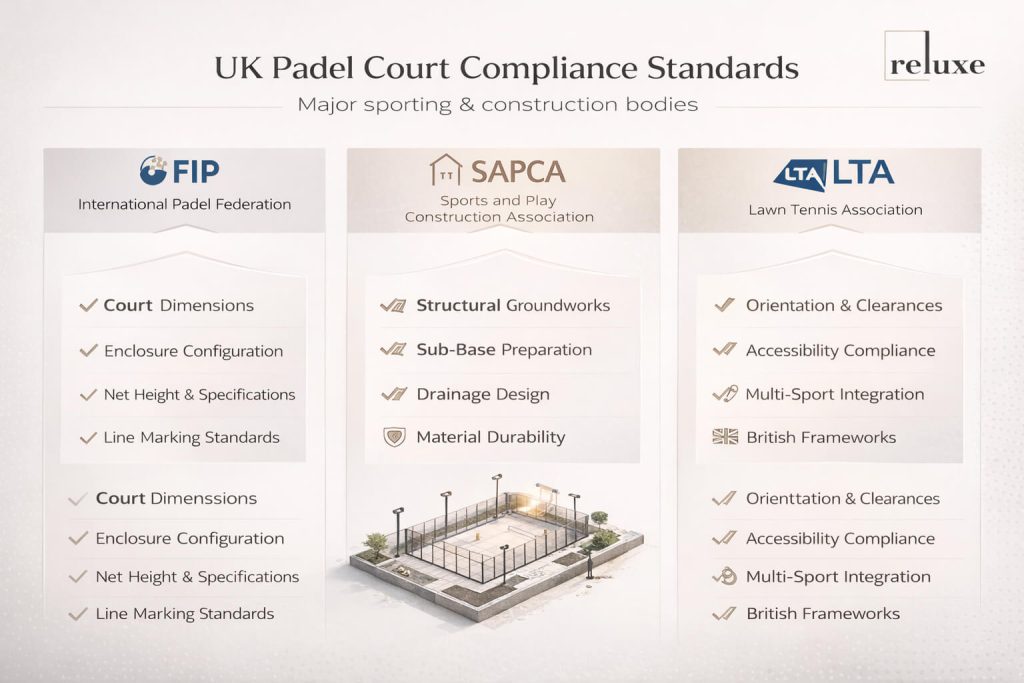
While many court systems are manufactured to international specifications, successful UK delivery requires alignment with domestic regulatory frameworks as well as sporting standards. Courts must be designed to meet UK sporting and building regulation standards, not just international sport specifications.
FIP Compliance
The International Padel Federation (FIP) defines the core technical standards governing court geometry and enclosure configuration. These standards ensure consistency of play at the competitive level and are widely adopted across the UK market.
Key FIP requirements include:
- Internal playing area of 20 metres x 10 metres
- Net height of 0.88 metres at centre
- Rear glass walls measuring 3 metres in height, with 1 metre of mesh fencing above
- Side enclosures comprising glass and mesh panels
- Line markings at 5cm width with high-contrast visibility
Adherence to FIP standards ensures predictable ball rebound, structural alignment and compatibility with competitive play. However, FIP compliance alone does not guarantee suitability within a UK planning or building control environment.
SAPCA Code of Practice
In the UK, the Sports and Play Construction Association (SAPCA) provides technical guidance for padel court construction through its Code of Practice. This document addresses construction methodology, surface performance, sub-base preparation and structural stability expectations specific to UK conditions.
SAPCA guidance places emphasis on:
- Groundworks tolerances and slab flatness
- Reinforced concrete ring beam construction
- Drainage integration for outdoor installations
- Surface performance and infill specification
- Long-term durability and corrosion protection
Where FIP focuses on sporting geometry, SAPCA focuses on build quality and performance longevity within UK environmental conditions. Courts delivered without regard to these construction standards frequently encounter settlement issues, enclosure misalignment or premature surface wear.
LTA Guidance
The Lawn Tennis Association (LTA), as the national governing body for padel in Great Britain, provides strategic and operational guidance for venue development. While not a construction manual in itself, LTA guidance influences planning approval, funding eligibility and operational alignment.
LTA guidance reinforces:
- Appropriate court orientation
- Minimum safety clearances
- Integration within multi-sport facilities
- Accessibility expectations
- Compliance with national sporting frameworks
Developments seeking funding or strategic alignment with the LTA must demonstrate adherence to these broader considerations.
Minimum Dimensions & Spatial Planning
The standard playing envelope of 20m x 10m represents only the internal enclosure. In practice, additional space is required to ensure safe access, spectator circulation and maintenance clearance.
For commercial multi-court developments, designers must also consider:
- Spacing between adjacent courts
- Emergency egress routes
- Circulation zones for players and staff
- Viewing areas and operational pathways
Indoor facilities must also account for vertical clearance.
Height Clearance (Indoor)
While a minimum ceiling height of 6 – 7 metres is often cited for indoor padel, this threshold is restrictive in commercial environments. Competitive play, lighting fixture depth and mechanical services integration all influence usable clearance.
In practice, a clear internal height of 8 metres or greater delivers superior performance and flexibility. Lower heights may compromise lob play, restrict lighting design options and create glare or service clashes.
Indoor-specific considerations are explored further in
Indoor padel court construction in the UK.
Court Enclosure Specifications
Padel courts are enclosed structures comprising tempered glass and galvanised or powder-coated steel framing. Precision alignment is critical. Even minor deviations can alter ball rebound behaviour and introduce structural stress over time.
Enclosures must be:
- Engineered for wind loading (outdoor installations)
- Properly anchored to reinforced concrete ring beams
- Designed to prevent vibration transfer
- Installed to tight tolerance specifications
In commercial environments, enclosure integrity is directly linked to acoustic behaviour and long-term safety.
Glass & Steel Standards
Tempered safety glass panels typically range from 10 – 12mm in thickness and must be installed flush within the supporting frame. Structural steel components require corrosion protection appropriate to the installation environment, particularly in exposed outdoor or coastal locations.
UK building control requirements may also require:
- Structural engineer certification
- Fire safety integration for indoor facilities
- Compliance with relevant British Standards
The combination of sporting geometry and structural engineering must be resolved before installation commences.
Compliance Beyond the Court
Padel courts in the UK sit within wider regulatory frameworks, particularly in relation to:
- Planning permission
- Floodlighting impact
- Noise assessments
- Drainage and surface water management
- Accessibility under building regulations
These requirements are addressed in detail in
Padel planning permission in the UK.
Indoor vs Outdoor Padel Court Construction in the UK
The technical demands of padel court construction vary significantly depending on whether the facility is delivered indoors or outdoors. While the playing geometry remains consistent, the environmental, structural and regulatory variables are fundamentally different.
Successful projects recognise these differences early in the feasibility stage. Attempting to apply a standardised approach across both environments often leads to compromised performance, increased cost or avoidable planning complications.
3.1 Indoor Courts
Indoor padel construction requires a higher degree of environmental control and structural coordination than outdoor installations. Courts are introduced into enclosed volumes where lighting, air movement, acoustics and structural interfaces must all be carefully managed.
Ceiling Height
A minimum clear height of 7 metres is commonly referenced for indoor padel courts. In practice, this is often restrictive. Competitive play, lighting fixture depth and mechanical services integration reduce usable clearance further.
A clear internal height of 8 metres or greater is strongly recommended in commercial environments. This allows:
- Unrestricted lob play
- Proper lighting positioning
- Safe clearance from roof beams and services
- Greater flexibility for tournament-level use
Warehouse structures that appear suitable on plan frequently lose height due to steel beams, ductwork or suspended services. Early measurement of true clear height is essential.
Lighting Performance & Glare Control
Indoor courts rely entirely on artificial lighting. While 500 Lux is widely accepted as a baseline illumination level, Lux alone does not guarantee quality.
Effective indoor lighting design must address:
- Uniform distribution across the playing surface
- Glare control, particularly near glass panels
- Avoidance of shadowing between multiple courts
- Colour temperature consistency
- Integration with emergency lighting systems
Poor fixture positioning or insufficient modelling can result in visual fatigue, reduced ball visibility and compromised player experience.
Ventilation & Condensation
Condensation is one of the most common indoor padel failures in the UK climate. Player activity generates humidity, which condenses rapidly on cold glass surfaces without adequate airflow management.
Mechanical ventilation systems are typically required to regulate:
- Temperature stability
- Relative humidity
- Airflow direction across glass panels
- Extraction rates during peak usage
Without proper ventilation and dehumidification, visibility degrades, turf performance is affected, and long-term enclosure integrity may suffer.
Acoustic Management
Padel is an impact sport. In enclosed environments, sound reflects and amplifies quickly. Reverberation can affect player comfort and may raise concerns in mixed-use or residentially proximate sites.
Indoor acoustic design must consider:
- Impact noise from ball strikes
- Vibration transfer through the slab and steel frames
- Reverberation time within the hall
- Transmission to adjacent occupiers
Acoustic treatment is significantly more effective when incorporated into the design phase rather than retrofitted after installation.
Warehouse Conversions
Industrial conversions represent a major growth area for UK padel development. They also present distinct technical risks.
Key assessment areas include:
- Slab load capacity and structural integrity
- Floor flatness and tolerance compliance
- Existing fire strategy and means of escape
- Building services capacity (electrical load, ventilation)
- Accessibility upgrades
Many warehouse slabs were not designed to support the concentrated loads of enclosed steel-framed sports structures. Structural assessment and, where necessary, slab reinforcement may be required prior to installation.
Indoor-specific engineering considerations are explored in greater depth in
Indoor padel court construction in the UK.

3.2 Outdoor Courts
Outdoor padel court construction introduces a different set of technical priorities, centred around environmental exposure, structural resilience and long-term durability.
Drainage Systems
Effective drainage is critical in UK outdoor installations. Standing water compromises surface performance, accelerates wear and may undermine structural elements.
Drainage design typically includes:
- Free-draining sub-base layers
- Perimeter drainage channels
- Appropriately fall within the surrounding hardstanding
- Integration with site-wide surface water management
Failure to manage water movement at ground level can lead to settlement and enclosure misalignment over time.
Wind Load Calculations
Padel courts are partially enclosed structures comprising glass and mesh panels. In exposed locations, wind loading becomes a primary structural consideration.
Engineering design must account for:
- Local wind speed data
- Panel anchoring strength
- Ring beam reinforcement
- Lateral stability of steel frames
Inadequate wind load assessment can result in glass stress, structural movement or long-term safety risks.
Corrosion Protection
Outdoor steel components must be protected against corrosion, particularly in coastal or high-exposure environments. Galvanisation, powder coating and appropriate fixings are essential to maintain structural integrity over time.
Material selection should consider:
- Environmental exposure classification
- Maintenance access
- Long-term lifecycle performance
Canopy Integration
Many UK operators choose to introduce canopies or full enclosures to extend year-round usability. While commercially attractive, canopies introduce additional structural complexity and often influence planning strategy.
Design considerations include:
- Additional wind load on the supporting structure
- Foundation reinforcement
- Rainwater management
- Lighting integration
- Visual impact within the planning context
Canopy engineering requires coordination between structural designers and court installers. Further detail is provided in
Padel court canopy construction in the UK.
Ground Stability
Subsurface conditions vary widely across UK sites. Soil type, historic use and groundwater levels influence foundation design and ring beam specification.
Pre-construction ground investigation helps determine:
- Required excavation depth
- Sub-base composition
- Reinforcement strategy
- Long-term settlement risk
Outdoor performance is directly linked to the integrity of the underlying structure.
Indoor and outdoor padel construction share the same sporting envelope but demand different engineering responses. Understanding these differences at the outset ensures that performance, durability and compliance are delivered from day one.
Groundworks, Foundations & Structural Engineering
The long-term performance of a padel court is determined well before the enclosure is installed. While the glass and steel structure is the visible element, the stability, accuracy and durability of the court depend on the groundworks and structural design beneath it.
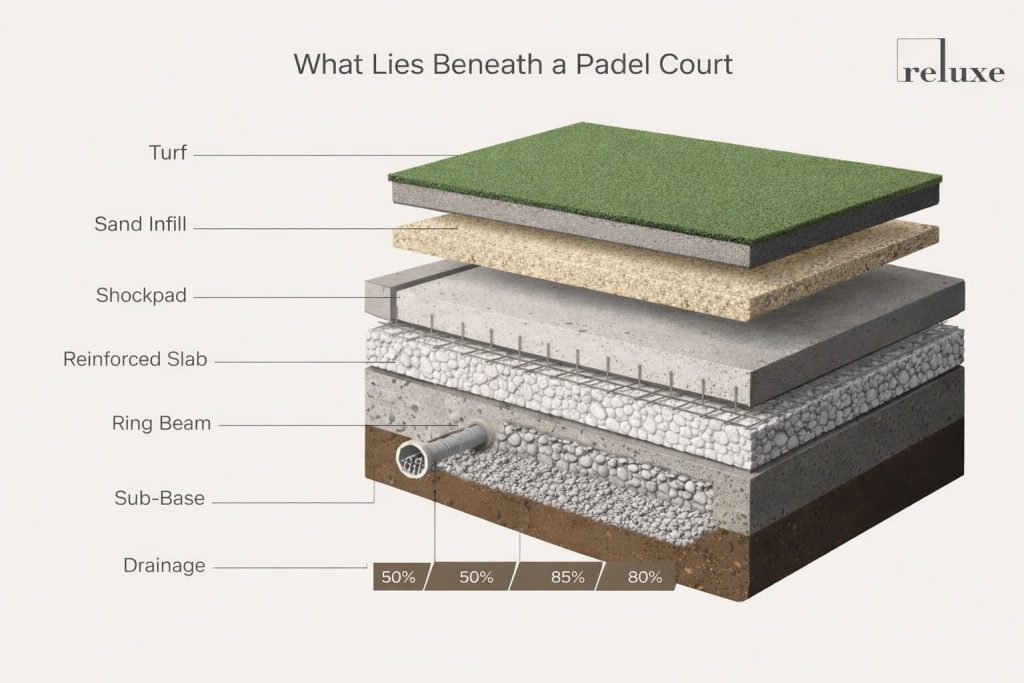
In UK construction environments, particularly within commercial multi-court developments, precision slab preparation and structural coordination are fundamental. Errors at the foundation level cannot be corrected once the enclosure is in place.
Reinforced Concrete Slab Specification
Padel courts require a structurally reinforced concrete slab designed to provide a stable, level and load-bearing platform for the enclosure system.
Typical considerations include:
- Structural-grade reinforced concrete
- Designed slab thickness based on load calculations
- Integration with drainage (outdoor installations)
- Isolation from surrounding structural movement
Unlike porous asphalt systems used in some sports applications, padel slabs must maintain tight flatness tolerances to ensure consistent ball rebound and enclosure alignment.
Where indoor courts are installed within existing buildings, slab integrity must be assessed prior to installation. Existing industrial floors may require strengthening or levelling before courts can be safely anchored.
Ring Beam Construction
The reinforced concrete ring beam forms the structural interface between the slab and the court enclosure. It anchors the steel frame and glass panels, transferring loads safely into the foundation.
The ring beam must be:
- Reinforced in accordance with the structural engineer’s design
- Cast to precise dimensional tolerances
- Fully aligned with enclosure fixing points
- Protected against water ingress (outdoor courts)
Insufficient reinforcement or inaccurate positioning can lead to misalignment, vibration transfer or structural stress within the glass panels.
Tolerances & Flatness
Flatness tolerances are critical in padel construction. Minor deviations in slab level can alter ball behaviour and affect structural stability.
Construction teams must control:
- Surface-level variation across the full 20m x 10m footprint
- Alignment between adjacent courts in multi-court developments
- Transition tolerances between the slab and the ring beam
Precision at this stage ensures the enclosure is installed square and true, protecting both performance and safety.
Vibration Isolation
Padel is an impact sport. Without appropriate isolation, vibration energy from ball strikes and player movement can transfer into the surrounding structure, particularly in indoor warehouse conversions.
Best practice includes:
- Isolation joints between the slab and the surrounding structure
- Controlled anchoring detail for steel frames
- Assessment of vibration pathways within shared commercial environments
This becomes particularly relevant in mixed-use sites where noise transmission must be controlled.
Load-Bearing Requirements
The enclosure system comprises tempered glass and steel framing. These elements exert concentrated loads at anchor points, particularly under wind loading (outdoor courts) or dynamic use conditions.
Structural design must verify:
- Slab capacity for point loads
- Lateral stability under wind forces
- Compatibility with canopy or enclosure structures (where applicable)
- Interaction with existing building structure (indoor installations)
Where necessary, structural reinforcement must be incorporated into the foundation design.
Structural Engineer Sign-Off
In regulated UK construction environments, structural engineer certification is often required prior to installation and commissioning. This may include:
- Foundation design verification
- Load calculation sign-off
- Compliance with relevant British Standards
- Confirmation of safe anchoring methodology
Early engagement with structural engineers avoids delays and ensures the enclosure system is installed onto a verified foundation.
The delivery of the UK’s largest padel centre in Bristol demonstrates the importance of coordinated groundworks and structural accuracy in multi-court commercial developments.
See the project:
UK’s Largest Padel Centre – Bristol
Further technical detail on sub-base design, slab construction and ring beam engineering is covered in
Padel court groundworks and foundations.
Groundworks are not a preparatory afterthought. They are the structural foundation upon which performance, compliance and long-term durability depend. In UK padel construction, precision at the foundation level protects both investment and operational integrity.
Planning Permission & UK Regulatory Considerations
In the UK, padel court construction rarely sits outside the planning and building control framework. Even where courts are installed within existing sites, statutory approvals, compliance reviews and regulatory coordination are typically required before construction can proceed.
Understanding planning strategy at the feasibility stage reduces risk, protects programme timelines and avoids costly redesign. Padel facilities that fail to account for local authority expectations often encounter objections relating to lighting, noise, traffic impact or change of use.
Change of Use
Where padel courts are introduced into existing industrial units, retail environments or mixed-use sites, a change-of-use application may be required under the Town and Country Planning (Use Classes) framework.
Local authorities will assess:
- The existing lawful use of the site
- Proposed operational hours
- Impact on neighbouring occupiers
- Traffic and parking provision
- Compatibility with local development policy
Early planning review determines whether full planning consent is required or whether permitted development rights may apply in limited circumstances.
Floodlighting Restrictions
External padel courts almost always require floodlighting to support evening use. Lighting design, therefore, becomes both a technical and planning matter.
Local authorities typically assess:
- Lux levels at the site boundary
- Light spills into neighbouring residential areas
- Column height and visual impact
- Operational hours
Lighting reports and photometric modelling are often required as part of planning submissions. Poorly considered lighting design can result in objections or operational restrictions.
Noise Impact Assessments
Padel generates repetitive impact noise from ball strikes and player movement. In residentially proximate locations, this can trigger the requirement for a formal noise impact assessment.
Acoustic consultants may be engaged to assess:
- Baseline ambient noise levels
- Predicted peak impact levels
- Reverberation within enclosed environments
- Mitigation measures such as acoustic fencing or canopy design
Noise considerations are particularly important for evening operation or sites near housing.
Residential Proximity
Where courts are located adjacent to residential properties, local authorities will review potential impacts relating to:
- Noise
- Lighting
- Privacy
- Increased footfall
- Car park usage
Mitigation strategies may include restricted hours, acoustic screening, revised layout or lighting adjustments. Proactive engagement with planning officers can significantly improve approval outcomes.
Biodiversity Net Gain (BNG) & Drainage Compliance
Recent UK planning policy places increasing emphasis on Biodiversity Net Gain (BNG) and sustainable drainage. Outdoor padel developments may require:
- Biodiversity assessments
- Drainage strategy reports
- Sustainable drainage system (SuDS) integration
- Surface water attenuation
Even relatively small-scale leisure developments can trigger these considerations, particularly where new hardstanding or impermeable surfaces are introduced.
Fire Strategy & Means of Escape (Indoor)
Indoor padel facilities must comply with building regulations relating to fire safety and safe egress. This is particularly relevant in warehouse conversions or multi-court commercial centres.
Key considerations include:
- Clear emergency exit routes
- Travel distance compliance
- Emergency lighting
- Fire alarm integration
- Occupancy calculations
Court layout must not obstruct escape paths, and ancillary areas such as reception, retail or F&B must be incorporated into the overall fire strategy.
Our approach to coordinating design, compliance and programme across regulated leisure environments is explored in more detail in
From planning to completion: managing complex leisure projects.
Further planning-specific guidance is provided in
Padel planning permission in the UK.
Planning permission and regulatory compliance are not peripheral concerns. They shape layout decisions, lighting strategy, acoustic design and operational viability from the earliest stage. Successful UK padel construction integrates these requirements into the project framework from day one.
Commercial Multi-Court Developments
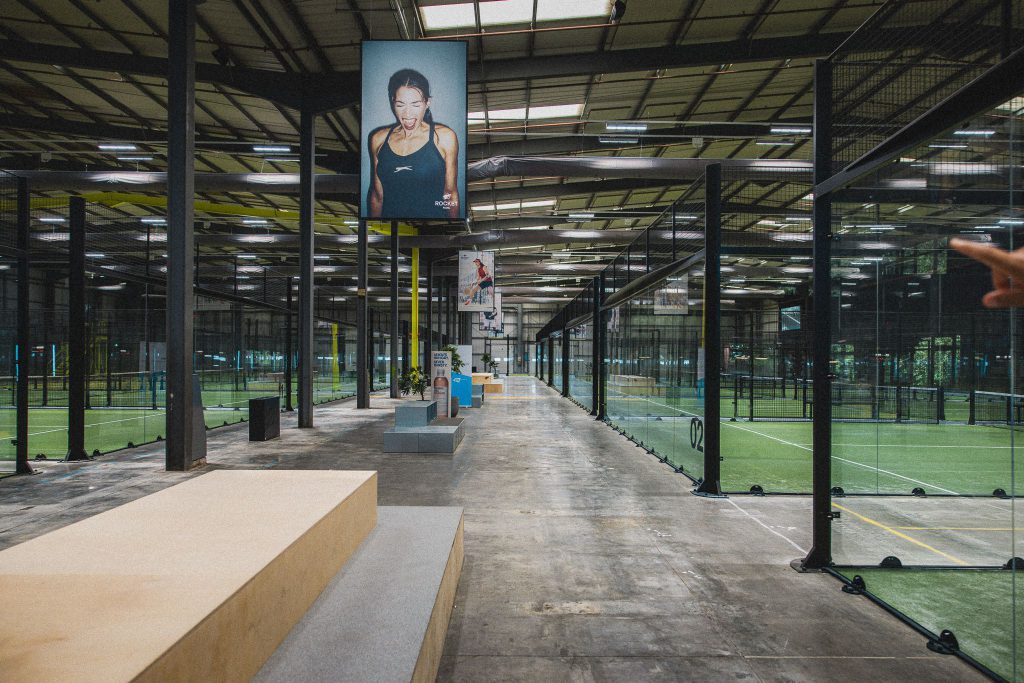
The UK padel market is increasingly defined by multi-court commercial facilities rather than single recreational installations. While a standalone court may suit private or community use, commercial operators typically require two, four, eight or more courts delivered within a coordinated leisure environment.
This is where the distinction between installer and construction partner becomes clear.
Multi-court facilities demand integrated commercial planning, structural coordination and operational foresight. The court system is only one component within a broader development framework.
2 – 12 Court Facilities
Commercial viability often improves as court numbers increase, allowing operators to scale programming, membership models and event hosting.
However, larger court clusters introduce additional design considerations:
- Structural load distribution across extended slab areas
- Lighting uniformity across multiple courts
- Acoustic management in enclosed volumes
- Efficient circulation between courts
- MEP capacity planning
Delivering a four-court facility differs significantly from delivering a twelve-court flagship centre. Engineering, services integration and programming flexibility must scale accordingly.
The delivery of the UK’s largest padel centre demonstrates the structural and operational coordination required at this scale:
UK’s Largest Padel Centre – Bristol
Circulation & Spacing
Adequate spacing between courts is critical for both playability and safety. Competitive players frequently move beyond enclosure boundaries during play, particularly in high-level environments.
Design must account for:
- Clear circulation routes
- Player access without crossing active courts
- Emergency egress pathways
- Maintenance access
Insufficient spacing compromises both user experience and regulatory compliance.
Spectator Areas
Padel’s spectator appeal has contributed to its commercial growth. Tournament hosting, corporate events and league play require provision for viewing areas.
In multi-court environments, this may include:
- Elevated viewing platforms
- Perimeter standing zones
- Integrated seating
- Clear sightlines across courts
Structural design must accommodate additional loads where spectator areas are introduced.
Ancillary Retail & F&B Integration
Modern padel centres frequently integrate:
- Reception and retail areas
- Pro shops
- Changing facilities
- Food and beverage offerings
- Social lounge spaces
These elements significantly influence layout strategy and building services coordination. The integration of leisure and retail components requires fit-out experience beyond court installation alone.
Our work within high-footfall commercial environments provides further context on integrating leisure and retail uses:
What makes a successful commercial fit-out in high-footfall locations
Programming Flexibility
Commercial operators require facilities capable of accommodating:
- Social bookings
- Coaching programmes
- Corporate events
- Tournaments
- League play
Design decisions such as court spacing, lighting, zoning and acoustic control influence programming flexibility. Multi-court facilities must allow courts to operate independently or collectively, depending on demand.
Phased Delivery
Large-scale padel developments are sometimes delivered in phases, particularly within regeneration sites or mixed-use destinations.
Phased delivery may involve:
- Sequential slab construction
- Staggered enclosure installation
- Incremental services commissioning
- Integration with wider landlord programmes
Careful programme management ensures operational readiness without disrupting adjacent works.
The delivery of high-profile London sites illustrates the complexity of coordinating padel construction within active commercial environments:
Multi-court commercial padel developments are not defined solely by the number of courts installed. They are defined by structural precision, operational design and integration within wider leisure environments.
Delivering facilities at this scale requires construction expertise, programme management and commercial understanding that extends beyond the court enclosure itself.
Padel Court Construction Costs in the UK
The cost of padel court construction in the UK varies depending on site conditions, number of courts, structural requirements and environmental factors. While no two projects are identical, benchmark ranges provide a useful framework for early-stage feasibility and financial modelling.
Cost should always be assessed in the context of planning complexity, structural engineering requirements and operational objectives rather than viewed solely as a product purchase.
Single Court Benchmark Range
For a standard outdoor padel court in the UK, typical construction benchmarks (excluding complex site constraints) generally fall within:
- £55,000 – £80,000 per court
This range typically includes:
- Reinforced concrete slab
- Ring beam construction
- Court enclosure system (glass and steel)
- Artificial turf installation
- Basic LED lighting
Site-specific conditions such as ground remediation, restricted access or enhanced acoustic measures will increase costs.
2 – 4 Court Facility Range
Where multiple courts are delivered within a coordinated development, economies of scale may apply to certain elements (mobilisation, shared services infrastructure, drainage).
Indicative benchmark ranges for a 2 – 4 court outdoor facility typically fall within:
- £140,000 – £300,000+, depending on site complexity and specification
This may include:
- Expanded slab areas
- Coordinated lighting layouts
- Integrated access pathways
- Shared drainage infrastructure
However, commercial facilities often incorporate additional elements that significantly influence overall capital cost.
Indoor Uplift Factors
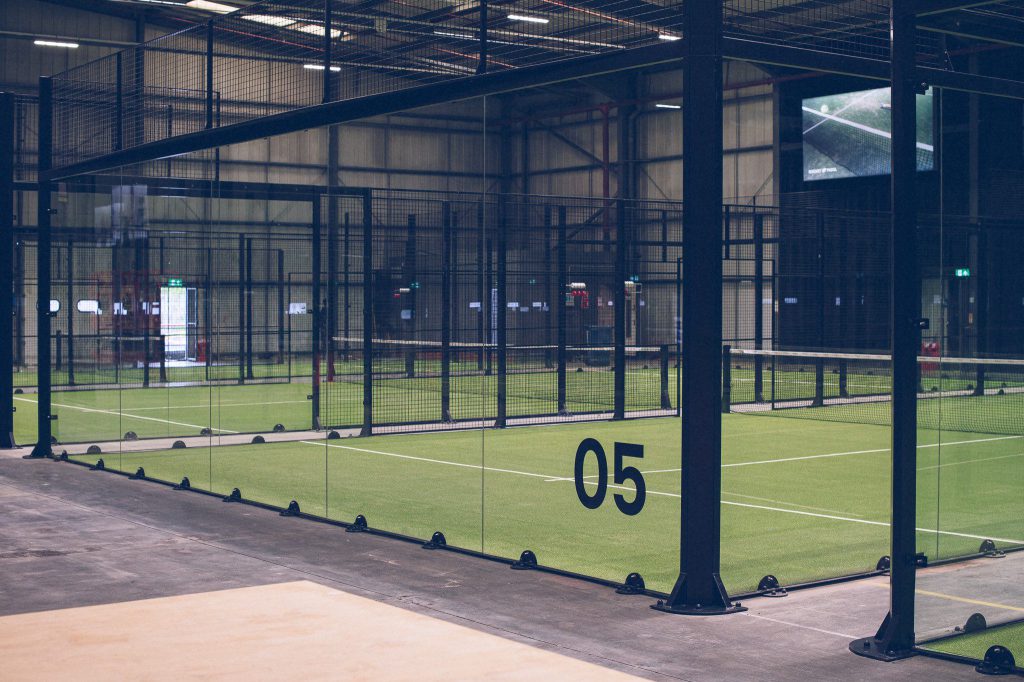
Indoor padel construction typically carries a higher capital cost than outdoor installations due to environmental control and building compliance requirements.
Indoor cost drivers include:
- Mechanical ventilation and extraction systems
- Dehumidification to prevent condensation
- Enhanced lighting installations
- Acoustic treatment
- Structural modifications to existing buildings
- Fire safety and building regulation compliance
Depending on building condition and services capacity, indoor projects can increase base court costs by 20 – 40% or more.
Warehouse conversions frequently require additional slab preparation or structural reinforcement before installation can proceed.
Canopy Cost Factors
Canopies and semi-enclosed structures are often introduced to extend year-round usability of outdoor courts. While commercially attractive, canopies introduce additional engineering complexity.
Cost variables include:
- Structural steel framing
- Foundation reinforcement
- Rainwater management systems
- Wind load engineering
- Integrated lighting systems
Canopy structures may add £40,000 – £100,000+ per court, depending on span, specification and planning requirements.
These considerations are explored further in
Padel court canopy construction in the UK.
MEP Cost Implications
Mechanical, electrical and plumbing (MEP) systems represent a significant cost variable in commercial padel developments.
Considerations include:
- Electrical capacity upgrades
- Distribution boards and lighting circuits
- HVAC systems (indoor facilities)
- Emergency lighting and fire alarm integration
- Drainage and surface water management
In multi-court commercial environments, MEP integration can account for a substantial proportion of total project cost.
Acoustic Cost Considerations
Where facilities are located near residential areas or within mixed-use developments, acoustic mitigation may be required.
Acoustic cost drivers include:
- Impact noise assessments
- Acoustic fencing or barriers
- Internal sound absorption systems
- Structural vibration isolation
Mitigation requirements vary by location and planning authority, but can materially affect budget forecasts.
While these benchmark ranges provide useful guidance, accurate cost modelling requires site-specific feasibility assessment, structural input and planning review.
A detailed breakdown of cost components, lifecycle considerations and commercial modelling is provided in
In UK padel construction, capital cost should be evaluated alongside regulatory complexity, long-term durability and operational viability. Early-stage financial clarity reduces risk and supports informed development decisions.
Construction Timeline & Delivery Phases
Successful padel court construction in the UK follows a structured delivery sequence. While programme length varies depending on planning requirements, site conditions and project scale, a clearly defined phased approach reduces risk and protects commercial timelines.
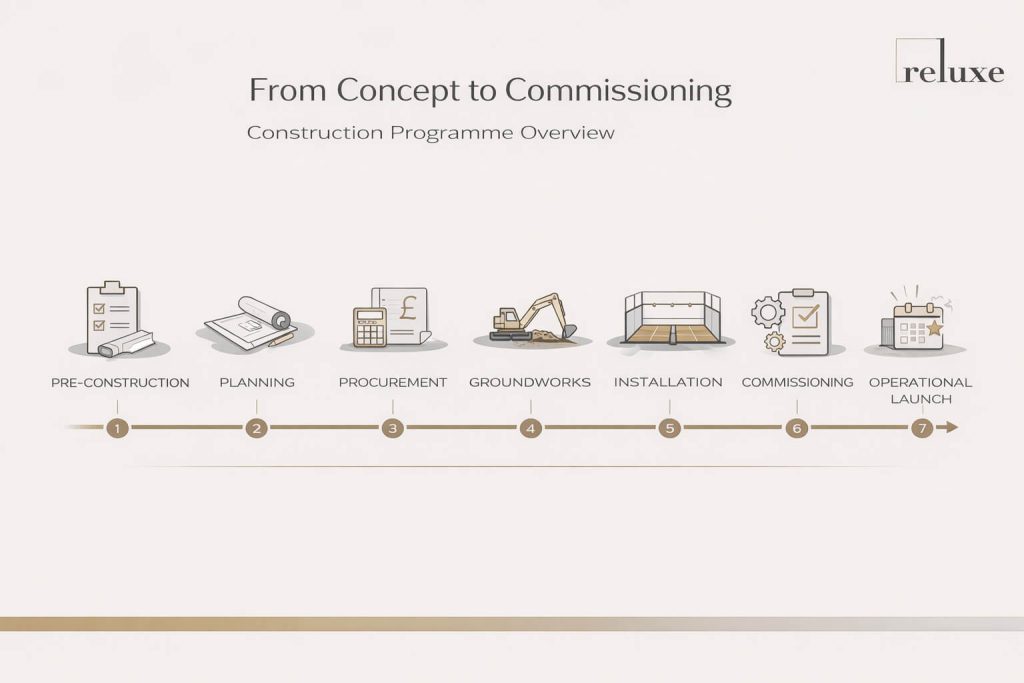
Multi-court commercial developments, in particular, benefit from early coordination between consultants, contractors and specialist installers. The following framework reflects a typical end-to-end delivery pathway.
1. Feasibility & Site Survey
Every project begins with a feasibility assessment. This stage establishes whether the proposed site is technically and commercially viable.
Key activities include:
- Site survey and topographical review
- Ground investigation (outdoor sites)
- Slab integrity assessment (indoor conversions)
- Review of existing building services
- Initial planning strategy discussion
- Budget benchmarking
At this stage, structural constraints, height limitations or drainage complexities can be identified before design investment escalates.
2. Design Coordination
Once feasibility is confirmed, coordinated design begins. This stage aligns sporting standards with structural engineering, services integration and commercial objectives.
Design coordination typically involves:
- Court layout planning
- Structural engineer input on slab and ring beam
- Lighting design modelling
- Ventilation and MEP coordination (indoor)
- Acoustic strategy (where required)
- Integration with ancillary spaces
For multi-court commercial environments, circulation, spectator zones and operational flow must also be resolved.
Reluxe manages this process through structured coordination and integrated programme control, as outlined in our
3. Planning Submission
Where planning consent is required, documentation is prepared and submitted during or immediately following the design coordination phase.
Planning documentation may include:
- Site layout drawings
- Lighting reports
- Noise impact assessments
- Drainage strategy
- Biodiversity or environmental reports
- Change-of-use applications
Planning approval timelines vary by local authority, and early engagement reduces delay risk.
4. Groundworks
Upon receipt of required approvals, site preparation and foundation works commence.
Groundworks typically include:
- Site clearance and excavation
- Drainage installation (outdoor projects)
- Sub-base preparation
- Reinforced concrete slab pour
- Ring beam construction
Precision at this stage is critical. Slab flatness, structural reinforcement and anchoring detail determine long-term performance.
5. Court Installation
Once foundations have cured and structural tolerances are verified, enclosure installation proceeds.
This phase includes:
- Steel frame installation
- Glass panel fitting
- Turf installation and sand infill
- Net and ancillary equipment fitting
In multi-court environments, installation sequencing is coordinated to optimise programme efficiency and minimise site congestion.
6. Lighting & Commissioning
Lighting systems, mechanical services and safety integrations are installed and tested during commissioning.
Commissioning includes:
- Lux level verification
- Glare assessment
- Electrical load testing
- Ventilation performance testing (indoor facilities)
- Acoustic performance validation (where required)
This stage ensures that the facility operates in accordance with design intent and regulatory requirements.
7. Final Inspection & Sign-Off
The final phase involves inspection and certification prior to operational handover.
This may include:
- Structural engineer sign-off
- Building control approval
- Fire safety compliance confirmation
- Snagging and rectification
- Handover documentation
Reluxe oversees this process as part of our integrated
Build services, ensuring that commercial facilities are delivered ready for operation.
The timeline for a single outdoor court may range from 6 – 10 weeks post-approval. Multi-court commercial facilities, particularly indoor developments, require extended coordination depending on structural and regulatory complexity.
Structured programme management ensures that padel facilities are delivered safely, compliantly and aligned with commercial launch objectives.
Choosing a UK Padel Construction Partner
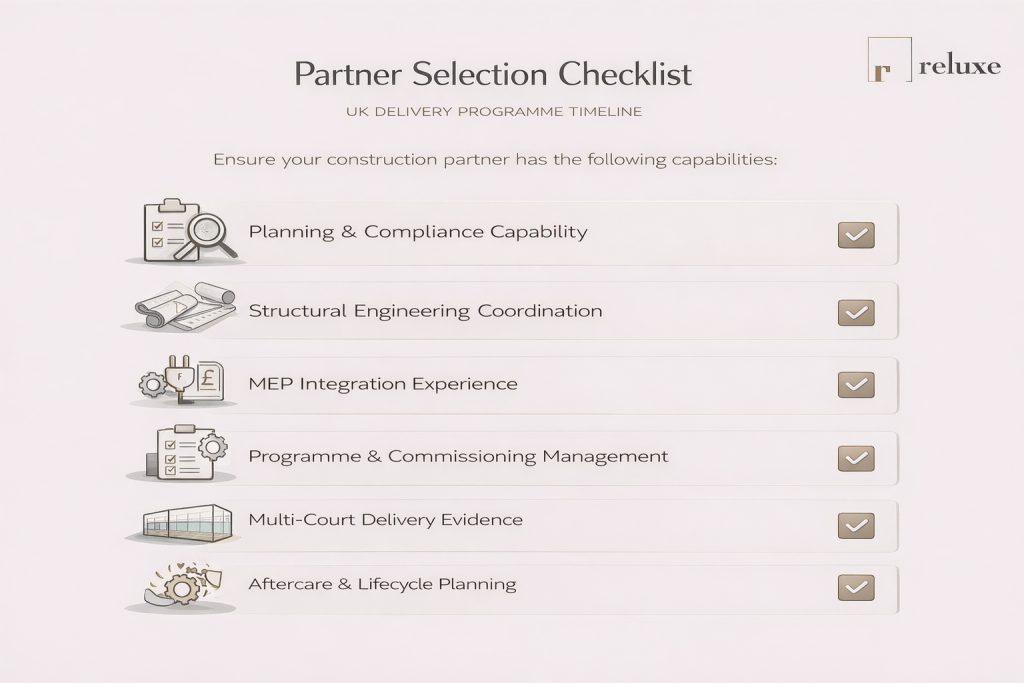
Selecting the right partner for padel court construction in the UK is a commercial decision as much as a technical one. While many companies can supply and install a court system, fewer have experience delivering regulated leisure environments within complex planning and operational frameworks.
For commercial operators, landlords and developers, capability extends beyond enclosure installation.
Experience Delivering Regulated Environments
Padel courts in the UK frequently sit within controlled planning contexts, mixed-use destinations and operational commercial sites. Delivery, therefore, requires familiarity with:
- Local authority processes
- Building control engagement
- Health and safety compliance
- Fire strategy integration
- Active site coordination
Experience in regulated environments reduces programme risk and ensures that compliance is integrated from the outset rather than addressed reactively.
Understanding Planning Strategy
Planning permission is often the defining factor in programme viability. A competent construction partner should understand:
- Change-of-use requirements
- Lighting and acoustic submission standards
- Residential proximity mitigation
- Biodiversity and drainage compliance
Early-stage planning awareness influences layout, orientation and lighting decisions before significant capital is committed.
Structural Coordination
Padel enclosures are precision steel and glass systems anchored to reinforced concrete foundations. Structural misalignment or inadequate load assessment can compromise long-term performance.
A suitable partner should coordinate:
- Structural engineer input
- Foundation design verification
- Slab tolerances and anchoring detail
- Wind load and canopy calculations
This level of coordination distinguishes commercial construction delivery from basic installation.
Commercial Programming & Operational Design
Multi-court facilities require integration between construction sequencing and commercial launch objectives.
Programming considerations may include:
- Phased installation
- Integration with wider retail or leisure fit-out
- Coordination with the landlord works
- Soft launch and commissioning timelines
Operators rely on predictable programme management to protect revenue forecasts and membership acquisition strategies.
Multi-Site Rollouts
As the UK padel market matures, operators are increasingly pursuing multi-site expansion. Consistency of specification, programme reliability and regulatory familiarity become critical across locations.
A partner experienced in delivering repeatable, scalable projects can support rollout strategies without sacrificing compliance or build quality.
Maintenance Planning & Lifecycle Awareness
Long-term asset performance depends on structured maintenance planning. Surface care, enclosure inspection and services maintenance must be considered at the construction stage.
An experienced partner understands:
- Lifecycle cost modelling
- Access provision for maintenance
- Material durability selection
- Operational downtime minimisation
Construction decisions influence operational expenditure long after handover.
Reluxe operates as a commercial construction partner rather than a product installer. Our experience delivering regulated leisure and retail environments underpins our approach to padel facility development.
Explore our portfolio of completed projects here:
To discuss feasibility, planning strategy or commercial rollout opportunities,
Frequently Asked Questions
A standard outdoor padel court in the UK typically costs between £55,000 and £80,000, depending on site conditions and specification.
Multi-court facilities benefit from shared infrastructure but introduce additional costs for lighting coordination, drainage and access works. Indoor installations are generally 20 – 40% higher due to ventilation, lighting, acoustic and fire safety requirements.
A detailed breakdown of cost variables is provided in our guide to
Padel Court Cost in the UK.
In most cases, yes.
Planning permission is commonly required for:
Outdoor court installation
Floodlighting
Change of use (e.g., warehouse conversion)
Multi-court commercial developments
Local authorities will assess lighting spill, noise impact, drainage, biodiversity and residential proximity. Indoor conversions may also require building control approval and fire strategy compliance.
Slab depth varies depending on structural engineering design and ground conditions, but reinforced concrete slabs are typically designed to support concentrated enclosure loads and long-term stability.
Key considerations include:
Structural reinforcement
Ring beam integration
Flatness tolerances
Wind load transfer (outdoor courts)
Slab specification should always be verified by a qualified structural engineer.
Construction timelines depend on planning approval and project complexity.
A single outdoor court may take 6 – 10 weeks from groundworks to completion (post-approval).
Multi-court or indoor facilities typically require a longer programme due to structural, MEP and compliance coordination.
Planning approval timelines vary by local authority and should be factored into overall programme forecasts.
The practical minimum ceiling height is 7 metres, but 8 metres or more is strongly recommended for competitive play and lighting flexibility.
Lower heights can restrict lob play and limit lighting installation options. Existing warehouse beams and services must be measured against clear playing envelope requirements.
Yes, many UK padel facilities are delivered through warehouse conversion.
However, feasibility must be assessed:
Slab load capacity
Floor flatness and tolerances
Ceiling clearance
Fire safety compliance
Ventilation and condensation control
Electrical capacity
Structural reinforcement or service upgrades are often required before installation can proceed.
Padel court construction in the UK combines sporting precision with regulatory compliance and commercial delivery. Early-stage feasibility and coordinated design are essential to ensure long-term performance and programme certainty.